
Digital Governance: The Balance Between Innovation and Systemic Risk in AI
- April 2, 2026
- Curiosities
- AI and data
In the global financial sector, digital maturity goes far beyond processing capacity; it is directly linked to resilience of governance. Recent data from Gartner and Deloitte indicate that security and regulatory compliance are the top investment priorities for most technology leaders in financial services.
For institutions operating at the top of the pyramid, such as large banks and large-scale fintech companies, compliance is not a competitive advantage—it is the barrier. Only technology partners operating under a strict regulatory framework can pass these institutions’ risk and compliance audits. Without governance, Artificial Intelligence (AI) is a risk; with it, it is a sustainable competitive advantage.
Below, we outline the key components that underpin an AI system designed for the highly demanding financial market.
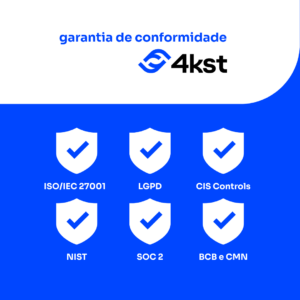
1. ISO/IEC 27001:2022 – The Culture of Risk Management
ISO 27001 is the foundation of any serious Information Security Management System (ISMS). Unlike one-off solutions, it establishes a cycle of continuous improvement (PDCA) that encompasses processes, people, and technology.
- Key Feature: In the context of AI, the standard ensures that the data lifecycle—from collection to model training—is protected against unauthorized access and manipulation that could compromise the results.
2. LGPD (Law No. 13,709/2018) – Transparency and Explainability
At the heart of the LGPD is data self-determination, which gives citizens back control over their own data trail. For the financial sector, the challenge lies particularly in Article 20, which deals with automated decisions.
- The Key Point: Regulated AI requires “explainability.” It is not enough for the machine to make the decision; the institution must be able to explain the criteria behind the decision (such as a credit denial or fraud block) to the account holder and the regulator.
3. CIS Controls v8.1 – Operational Cybersecurity
The Center for Internet Security (CIS) offers a set of 18 critical controls that translate abstract policies into concrete technical actions.
- The Distinctive Feature: While compliance focuses on standards, CIS focuses on attacks. It ensures that the infrastructure hosting AI has defenses against real threats in the financial market, such as credential leaks and network breaches.
4. NIST Cybersecurity Framework (CSF) v2.0 – Strategic Resilience
The NIST framework is the global standard for managing cyber risks. It organizes security into five key functions: Identify, Protect, Detect, Respond, and Recover.
- Key Feature: In critical operations, failure is a statistical possibility. NIST ensures that, should an incident occur, the technology has rapid recovery mechanisms in place to prevent the interruption of essential transactions (such as Pix).
5. SOC 2 (AICPA) – Validation of Delivery
SOC 2 is an independent assurance report focused on service providers. It validates five principles: Security, Availability, Processing Integrity, Confidentiality, and Privacy.
- The Key Feature: It is the technical “social proof.” It demonstrates to the bank’s auditors that the supplier not only claims it is secure, but that an independent auditor has verified that its controls operate effectively over time.
6. BCB Resolution No. 85/2021 and CMN Resolution No. 4,893/2021 – The Regulator’s Strict Approach
These resolutions apply specifically to the National Financial System (SFN). They set forth the requirements for contracting cloud and cybersecurity services.
- The Key Point: The key point here is shared responsibility. The Central Bank requires financial institutions to have full visibility and control over their critical suppliers, ensuring that technological innovation does not undermine the financial system as a whole.
Conclusion
In today’s highly complex regulatory landscape, compliance has evolved from a mere bureaucratic formality into the foundation that enables the scalability of secure technological solutions in critical markets. We understand that to serve major banks and elite financial institutions, it is not enough to simply deliver high-performance algorithms; we must deliver institutional peace of mind.
Today, 4kst operates in full compliance with all the standards and regulations mentioned above. Our maturity in digital governance is what allows us to integrate AI solutions directly into core of critical operations, ensuring that innovation is, above all, safe, ethical, and auditable.
About 4kst
4kst is a Brazilian DeepTech company born at PUCPR, a pioneer in the development of Adaptive AI. Through proprietary Data Stream Learning technology, we create predictive models that learn and update in real time. Unlike traditional Machine Learning, our solution eliminates performance degradation and reduces maintenance costs. Two-time winner of Febraban Tech and recognized by Finep, 4kst combines cutting-edge science and high performance to keep your company ahead in dynamic markets.
Related articles

Stay ahead
of the competition
Optimize your strategic decisions with the most assertive
forecasts on the market.
-
 LGPD compliance
 -
BCB Resolution 85/2021
-
ISO/ISE 27001:2022 certification