Imagine a corporate scenario where every decision, marketing action or risk analysis evolves immediately as new data emerges. It's no longer fiction. Welcome to the world of adaptive artificial intelligence, which adjusts in real time to meet the needs of the present and predict the demands of the future. Adapting to the unexpected is the new normal in business - and adaptive AI, with its unusual flexibility, is at the heart of this transformation.
Introduction: The New Frontier of AI
Artificial intelligence is no longer a novelty. It's in our smartphones, cars, banking systems and even healthcare. But there is a silent revolution taking place behind the scenes in the world of technology: the rise of Adaptive AI.
While traditional AI systems operate within predefined limits, Adaptive AI represents a fundamental evolution, capable of continuously learning, adjusting to new situations and autonomously improving over time. It's like comparing a static GPS with one that learns your travel patterns and adapts in real time to traffic, weather conditions and your personal preferences.
"Adaptive AI not only responds to the present, but evolves with the future, representing a paradigm shift in the way we build intelligent systems."
According to a Gartner study, 21% of CEOs see artificial intelligence as the most disruptive technology for business. It's no coincidence: it's never been more necessary to respond quickly to unpredictable events. If something goes wrong - such as economic fluctuations or changes in legislation - adaptive systems act on the spot.
Understanding Traditional AI: The Starting Point
Before we dive into the future, let's understand our starting point. Traditional AI (or symbolic AI) is like that coworker who strictly follows the instruction manual - efficient at specific tasks, but inflexible when unexpected situations arise. 🤖
Characteristics of Traditional AI
- Rule-based: Operates by following predefined instructions programmed by humans
- Static: After development, remains unchanged until manually updated
- Limited to specific tasks: Excellent in well-defined problems, but fragile in unforeseen scenarios
- Dependent on human intervention: Requires constant reprogramming to adapt to new situations
Expert systems, early versions of virtual assistants like Siri and Alexa, and spam filters are classic examples of this approach. They work well within the parameters for which they were designed, but have serious limitations in dynamic environments.
Traditional AI is like a highly specialized professional in a single task - impressive within their specialty, but unable to improvise or learn new skills without thorough training.

What is Adaptive AI and Why Does It Matter?
Adaptive AI represents a radical evolution in the way we build intelligent systems. Instead of operating in a closed loop of predefined knowledge, these systems have the intrinsic ability to continuously learn and evolve based on new data and experiences - even after their deployment. 🧠
Key characteristics that define Adaptive AI
- Continuous learning: Constantly processes and analyzes new information to acquire knowledge
- Real-time adaptability: Adjusts algorithms and decision-making processes when it encounters changes in the environment
- Self-improvement: Improve your own capabilities by identifying inefficient areas in your functioning
- Sophisticated problem solving: Develops differentiated approaches by learning from past experiences
"The difference between traditional and Adaptive AI is like comparing a static printed map with a navigation app that recalculates routes in real time based on traffic conditions."
This evolution in AI is not just incremental - it represents a fundamental paradigm shift. The table below clearly illustrates this transformation:
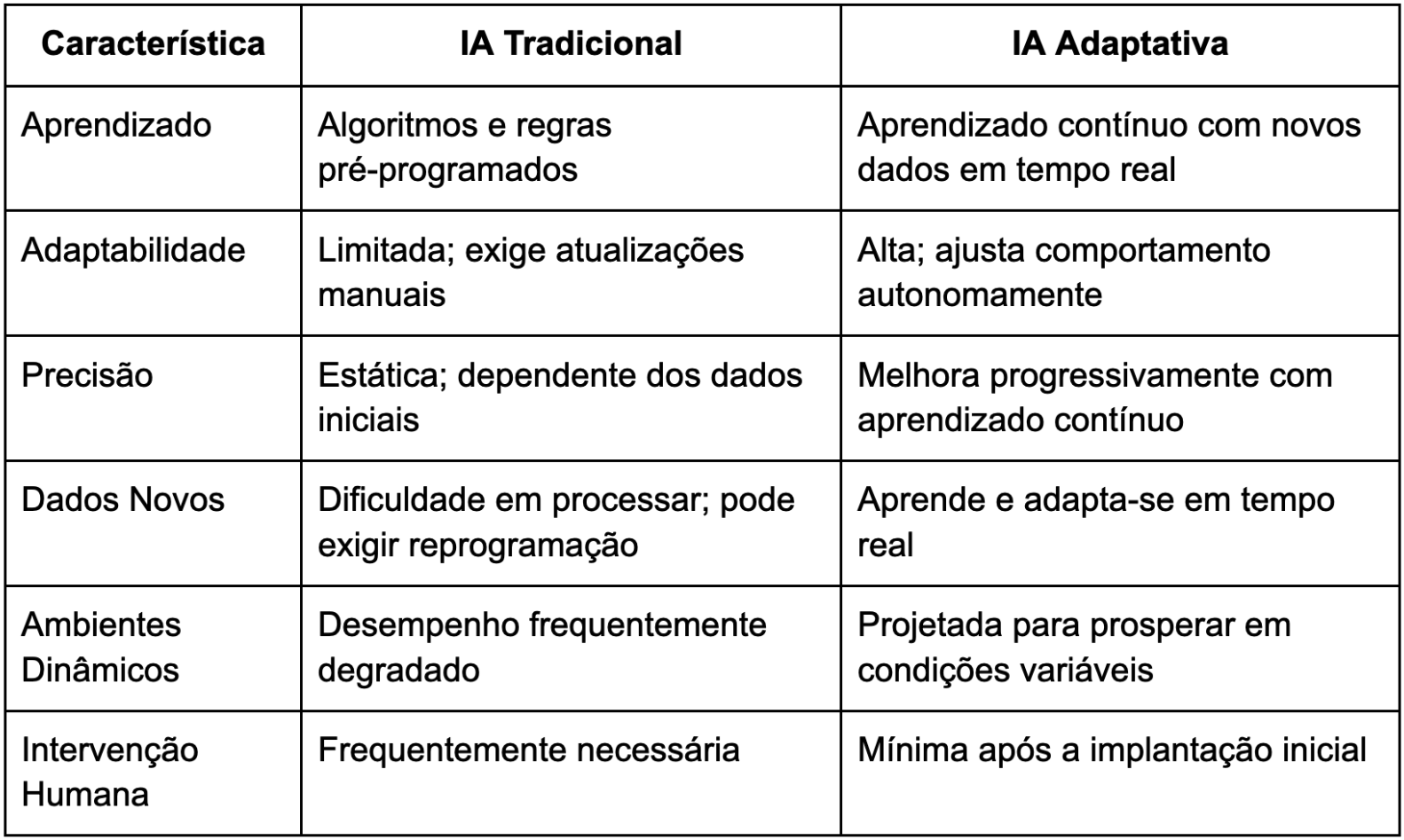
The importance of Adaptive AI is growing exponentially in a world where the only constant is change. In sectors characterized by high volatility, large volumes of data and the need for rapid response, systems that evolve continuously offer invaluable competitive advantages.
Adaptation Mechanisms: How the Magic Happens
AI's ability to adapt doesn't happen by chance - it's the result of the complex interaction between various components and advanced machine learning techniques. Let's uncover how this "magic" happens behind the scenes with the essential components. ✨
1. Machine Learning Algorithms: The fundamental basis that enables continuous data analysis and pattern discovery, including:
- Supervised learning
- Unsupervised learning
- Reinforcement Learning
2. Neural Networks and Deep Learning: Structures inspired by the human brain that process complex patterns in data, allowing AI to tackle intricate tasks. Deep learning involves neural networks with multiple processing layers.
3. Transfer Learning and Meta-Learning:
- Transfer Learning: Applies knowledge acquired in one task to another related task, accelerating learning.
- Meta-Learning: "Learning how to learn" - allows systems to optimize their own learning processes
4. Evolutionary Algorithms: Inspired by natural selection, they evolve models over "generations" to optimize performance and adaptability.
5. Continuous Learning Mechanisms: These allow the AI to actively seek out new information and update its knowledge in real time:
- Online learning
- Active learning
- Constant feedback loops
"True intelligence lies not just in knowing, but in the ability to learn, adapt and evolve. Adaptive AI embodies this fundamental principle."
These interconnected mechanisms create a system that not only performs predefined tasks, but evolves and improves with each interaction - similar to human cognitive development, but on a much larger scale and at a much faster rate.

Enhanced Accuracy: Numbers that Impress
One of the most significant advantages of Adaptive AI is its ability to continuously improve the accuracy of machine learning models. We're not talking about incremental improvements - the numbers are truly impressive in a number of sectors. 📊
a) Health
- Analysis of medical images with +99% sensitivity in the detection of fractures and tumors
- Diagnosis of breast cancer with progressively greater accuracy over time
- Detection of skin cancer through image analysis with higher accuracy rates than medical specialists
b) Finance
- Advanced fraud detection models achieving 94.2% accuracy with AUC-ROC of 0.96 (significantly higher than traditional methods)
- Adaptive systems that continually refine accuracy in identifying suspicious transactions
c) Software Development
- Test structures based on Adaptive AI reduce post-launch defects by up to 70% compared to conventional methods
d) Education
- Adaptive learning programs improving test scores by 62% compared to traditional methods
- AI teaching assistants achieving 97% accuracy when answering student questions
e) Marketing
- 95% accuracy in predicting purchase intent through adaptive learning
"The difference in accuracy between traditional and adaptive AI isn't just a matter of statistics - it translates directly into more accurate diagnoses, fraud avoidance and better business decisions."
This continuous improvement in accuracy clearly demonstrates that, in complex and dynamic environments, systems that continuously learn and adapt significantly outperform those that remain static after initial development.
Adaptive AI in Action: Real Use Cases
The theory is interesting, but the real value of Adaptive AI is revealed in its practical applications. Let's explore how various sectors are harnessing this technology to solve complex problems and create new opportunities. 🌐
Finance and Banking: Detecting Fraud in Real Time
In the financial sector, where transactions take place in milliseconds and fraudsters constantly develop new techniques, adaptability is crucial:
- Dynamic fraud detection: Systems that adjust instantly to identify evolving fraudulent activities
- Case study: PayPal uses Adaptive AI to evaluate transactions and continuously update its detection algorithms
- Personalized risk management: Dynamic adjustment of credit scores based on updated loan history and patterns
- Investment recommendations: Real-time analysis of market trends for personalized financial advice
The volatility inherent in the financial sector makes Adaptive AI not just an advantage, but a competitive necessity.
Health: Personalized Medicine and Precise Diagnoses
The healthcare sector is experiencing a revolution driven by AI's ability to continuously learn from medical data:
- Personalized medicine: Treatment plans that adapt continuously based on the patient's individual responses to therapy
- Advanced diagnostic imaging: Real-time analysis of X-rays and MRI scans for early disease detection
- Accelerating drug discovery: Predicting interactions between different components, shortening development cycles
- Predictive monitoring: Continuous analysis of patient data to predict complications before they manifest clinically
"In medicine, every patient is unique. Adaptive AI is bringing us closer to the ideal of truly personalized and precise treatments."
Retail: The Shopping Experience of the Future
Consumer behavior is constantly changing and retailers need to keep up:
- Hyper-personalized recommendations: Systems that continuously learn from interactions, browsing history and purchasing behavior
- Dynamic pricing: Algorithms that analyze market conditions, competitor prices and customer behavior in real time
- Intelligent inventory management: Demand forecasting based on historical sales data, market trends and external factors
Adaptive AI is enabling retailers to create personalized shopping experiences that evolve along with consumer preferences.
Supply Chain: Resilience in Uncertain Times
In a world of global disruptions and increasing volatility, adaptive supply chains are essential:
- Accurate demand forecasting: Continuous analysis of market trends and real-time sales data
- Optimized logistics: Determining the most efficient delivery routes and optimizing warehouse layouts
- Disruption management: Systems that learn from different data sources to minimize risks and improve resilience
Cyber Security: Dynamic Defense Against Threats
On the constantly evolving digital battlefield, static defenses are quickly overcome:
- Proactive threat detection: Continuous monitoring of network traffic and user behavior to identify anomalies
- Adaptive access control: security policies adjusted dynamically based on contextual factors in real time
- Response to emerging threats: Continuous learning from new attack patterns and automatic updating of security measures
Autonomous Vehicles: Learning at Every Turn
Perhaps no field demonstrates the power of Adaptive AI better than autonomous vehicles:
- Navigation in complex environments: Continuous learning with sensor data to adapt driving strategies
- Reinforcement learning: Development of ideal driving behaviors through trial and error
- Improved safety: Ability to react to unexpected situations and continuously improve driving skills
The success of autonomous vehicles depends fundamentally on AI's ability to learn and adapt in highly dynamic and unpredictable environments.
Challenges and Technical and Ethical Considerations: The Other Side of the Coin
Every transformative technology brings with it significant challenges, and Adaptive AI is no exception. Recognizing and addressing these issues is essential for responsible and beneficial implementation. ⚖️
a) Main technical challenges
- Data dependency: Need for large volumes of representative, high-quality data
- Algorithmic bias: Potential to perpetuate or amplify existing biases in the training data.
- Black box: Difficulty in interpreting and explaining decision-making processes in complex models
- Scalability: Significant computational requirements for training and real-time operation
- Security vulnerabilities: Risks associated with collecting and analyzing large amounts of data
- Skills gap: Shortage of professionals with the necessary expertise for development and implementation
b) Critical Ethical Considerations
- Justice and non-discrimination: Ensuring that systems do not perpetuate social prejudices, especially in sensitive areas.
- Transparency and explainability: Need to understand how decisions are made in order to build trust
- Responsibility: Define accountability when AI systems make mistakes or cause damage
- Data privacy and security: Protecting the vast amounts of personal data required
- Human autonomy: Questions about the appropriate level of human intervention in increasingly autonomous systems
"The real challenge of Adaptive AI is not only technical, but also ethical: how do we ensure that systems that continually evolve remain aligned with human values and social goals?"
Addressing these challenges requires a multidisciplinary approach, involving not only experts in technology, but also in ethics, law, public policy and social sciences.

Data: The Fuel of Adaptation
If Adaptive AI is the engine of the future of artificial intelligence, data is its essential fuel. The quality, quantity and diversity of the data available directly determine the effectiveness of these systems. 🔋
Why is data essential?
- Quality above all else: High-quality data is essential for effective learning and reliable results
- Volume matters: Large data sets allow systems to continually refine their algorithms
- Diversity is crucial: Representative and comprehensive data prevents bias and ensures effective operation in different scenarios
- Real time makes a difference: Real-time data flows enable continuous adaptation in dynamic environments
- Continuous learning (CL): Allows models to learn and adapt to new data over time.
- Robust infrastructure: Need for efficient systems for collecting, storing, processing and managing data
"Without a solid base of high-quality data, the promise of continuous learning and adaptation simply cannot be realized."
Organizations that want to harness the transformative power of Adaptive AI must prioritize the development of comprehensive data strategies and infrastructures that support the continuous flow of information needed to feed these intelligent systems.
Conclusion: The Future is Adaptive
The evolution from traditional AI to Adaptive AI represents much more than an incremental advance - it is a fundamental transformation in the way we build intelligent systems. In a world characterized by accelerating change and increasing complexity, the ability to learn continuously and adapt autonomously is not only desirable, but essential. 🚀
Adaptive AI is redefining what is possible in many sectors - from more accurate medical diagnoses and more secure financial systems to hyper-personalized consumer experiences and truly autonomous vehicles. The impressive results in terms of accuracy and performance clearly demonstrate the value of this evolutionary approach.
However, to fully harness the potential of Adaptive AI, we need to responsibly address its technical and ethical challenges. This requires not only engineering excellence, but also a commitment to fundamental human values such as fairness, transparency and privacy.
"The real revolution of Adaptive AI is not just in the technology itself, but in how it fundamentally changes our relationship with intelligent systems - from static tools that we program to dynamic partners that evolve with us."
As we move towards a future increasingly driven by artificial intelligence, organizations and societies that embrace the adaptive paradigm - prioritizing continuous learning, flexibility and evolution - will be better positioned to thrive in a world in constant transformation.
The future isn't just intelligent - it's adaptive.


 LGPD compliance