
Integrating a Custom Credit Score: What to Consider Before You Start
- June 3, 2026
- Credit
- Credit Decisions
- AI and data
The decision has already been made. Now here's the real question: Is your operation ready?
Getting this far means the case has already been made. You’ve understood the cost of an off-the-shelf credit score, reviewed the case studies, assessed the impact on the P&L, and concluded that a customized credit score makes sense for your business.
The question now is no longer whether it's worth it. It's how to do it right.
Integrating a custom credit score into the credit pipeline involves technical, governance, and data-related decisions that, if not properly assessed before implementation, can lead to delays, rework, and suboptimal results. This article covers what needs to be evaluated before getting started: data prerequisites, API integration issues, LGPD compliance requirements, and 4kst’s implementation workflow—from diagnosis to the model going live.
If you're still trying to decide whether now is the right time for your operation, the Article 3 in this series, “Credit Bureau Scores vs. Custom Scores: When Each Makes Sense,” provides a decision-making framework for this specific situation.
1. Data prerequisites: what you need to have before you start
Structured internal data
The key difference between a customized credit score and an off-the-shelf credit score lies in the internal operational data: transaction history, payment behavior, niche seasonality, and customer relationship patterns. These are the variables that improve the KS and reduce the gray area.
The prerequisite is that this data exists, is structured, and is accessible. It doesn’t need to be in a state-of-the-art data warehouse, but it does need to be in a system that allows for extraction and formatting—such as an ERP, CRM, portfolio management system, or consolidated spreadsheets with a consistent history. The format matters less than the data’s existence and quality.
History of Good and Bad Payers
To train a predictive model, you need a history of transactions with known outcomes: which customers paid, which went into default, and within what timeframe. The recommended minimum time window is 12 months, preferably 18 to 24 months, with sufficient volume to represent the different risk profiles within the niche.
Transactions with a history of less than 12 months are not ruled out; this will depend on the volume of historical data. In such cases, the initial model configuration may place greater weight on credit bureau data supplemented by available internal data, with scheduled recalibration as the historical data grows. The 4kst technical team evaluates the volume and quality of the historical data during the diagnostic phase.
Data Quality: What Really Matters
A large volume of low-quality data is not the solution. Three quality issues that compromise the model more than the absence of data:
- Inconsistency in the default criterion: If the criteria for defining a “delinquent borrower” change over time, the model will learn contradictory patterns. The criteria must be stable and well-documented.
- Systematic missing data: Variables with a high rate of missing values in specific periods distort the model. It is better to exclude the variable than to include it with significant gaps.
- Selection bias: The historical data reflects only the customers who were approved, not the entire pool of applicants. This is inherent in any credit operation, and the technical team knows how to handle it, but it must be documented.

2. API Integration: What to Consider from a Technical Perspective
How does the 4kst score integration work?
4kst’s Customized Credit Score is delivered via a REST API, with a latency of less than 40 ms in a production environment. The integration follows the standard process for a synchronous query in the credit pipeline: the operation sends the applicant’s data, and the API returns the score and the attributes relevant to the decision.
The platform is compatible with cloud-native architectures on the major cloud platforms—AWS, GCP, and Azure—and with any modern data stack. Integration does not require replacing existing systems. The customized score fits as an additional layer on top of the current pipeline.
What to evaluate from an operational perspective
- API call capability in the pipeline: Can the current origination system make synchronous calls to an external API at the time of analysis? In most modern stacks, yes. In legacy systems, this may require a middleware layer. In such cases, 4kst supports batch integration as an alternative, with the technical team guiding you through the most appropriate configuration.
- Validation environment available: The integration must be tested before going into production. A validation environment separate from the production environment is the minimum requirement for validating latency, load, and the score’s behavior across different requester profiles.
- Number of requests per second: Operations with peak volumes need to scale call capacity. 4kst scales the infrastructure according to the contracted volume, but this information must be provided during the diagnostic phase.
- Technical Lead for Integration: Integration is straightforward from a technical standpoint, but it requires a point of contact on the operations side to validate the tests and monitor the deployment. A developer or data architect with access to the pipeline can handle this.
Models without a real estate agency: the cost-saving option
For operations with a mature portfolio and extensive internal data, it is possible to configure the model without consulting a credit bureau, using only internal data and 4kst’s proprietary variables. This configuration reduces the cost per inquiry and can be an alternative for operations where the credit bureau already represents a significant portion of the CAC.
The decision between the three configurations—with a bureau, without a bureau, or hybrid—is made during the diagnostic phase based on the volume, the maturity of the historical data, and the model's performance objective.
3. The LGPD and Data Governance: What Needs to Be Addressed
The Legal Basis for the Use of Data in Predictive Modeling
The LGPD classifies the use of personal data for predictive credit modeling under two main legal bases: legitimate interest and performance of a contract. The choice of legal basis depends on the nature of the relationship with the customer and the type of data used.
What needs to be documented before getting started:
- Updated Privacy Policy: explicitly mentioning the use of data for credit analysis and predictive modeling.
- Legal basis identified and recorded: which article of the LGPD provides the legal basis for the use of each category of data used in the template.
- Record of Processing Activities (ROPA): Predictive modeling must be included in the company’s data processing activity log.
- Data Subject Rights Process: The customer has the right to know that their data is used in automated modeling and to challenge decisions based on it. This process must be in place before the model goes into production.
How 4kst handles transaction data
Data ingestion for model building and calibration takes place in an isolated, encrypted environment dedicated to this operation. A client’s data is never shared with other 4kst clients, is never used to train third-party models, and never leaves the contracted environment.
The architecture was designed to ensure that what 4kst calls the operation’s “informational gold”—the internal data that distinguishes the customized model from off-the-shelf scoring—remains exclusively at the service of the business intelligence of those who generated it.
Model Auditability
One requirement imposed by the LGPD that most operations underestimate: the model must be auditable. Automated credit decisions that affect data subjects must be explainable. This does not mean that the model must be a simple “white box” model, but it does mean that the operation must be able to answer: Why was this applicant rejected? Which variables carried the most weight?
4kst provides technical documentation for the model that supports this audit process, including the relative importance of the variables in the score and the validation criteria used in its development.

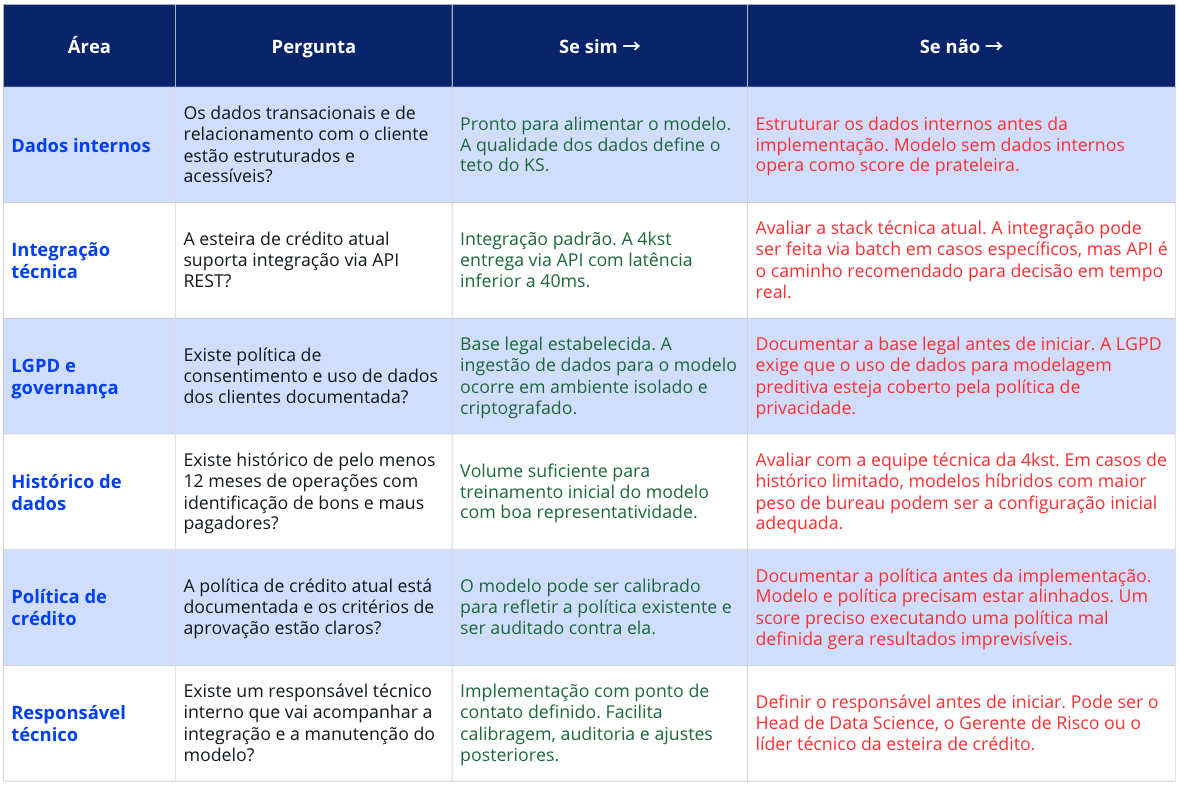
4. The Readiness Checklist: Assess Where Your Operation Stands
Before beginning any technical discussion, use the checklist below to assess the current state of your operation across the six critical dimensions for a successful implementation:
How to Interpret the Results
Mostly positive responses indicate that the operation is ready for immediate implementation. Negative responses regarding internal data or the LGPD indicate prerequisites that must be addressed before implementation. Negative responses regarding technical integration or the technical lead can be resolved during the process, with support from the 4kst team.
No single negative response is a definitive roadblock. The diagnosis made by the 4kst technical team in the initial phase pinpoints exactly what needs to be resolved, in what order, and by when.
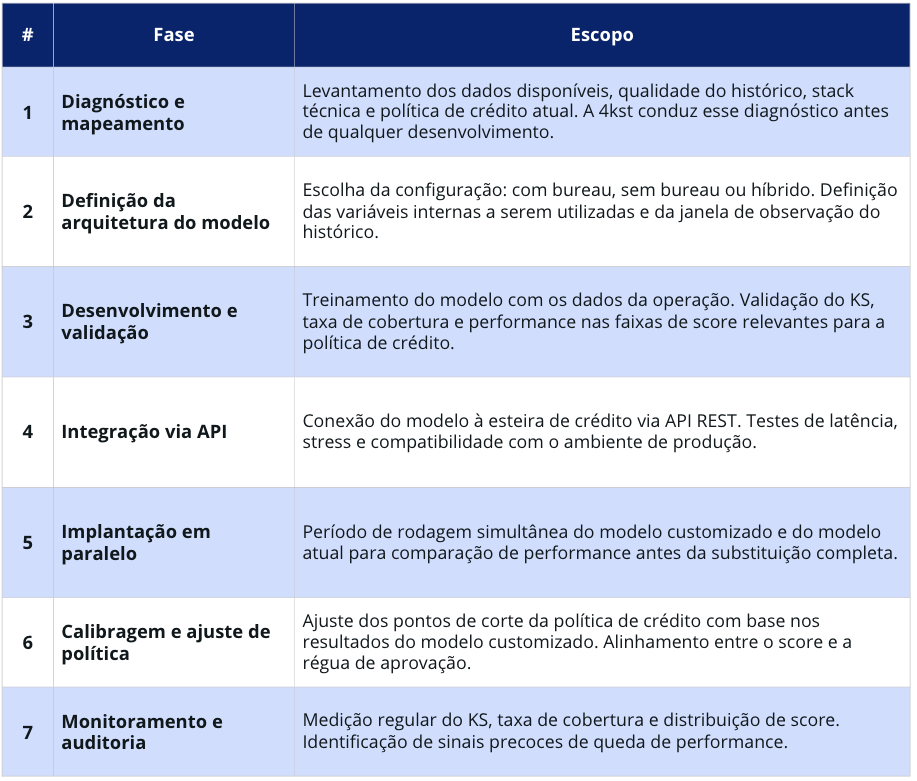
5. The 4kst implementation process: from assessment to production model
For those evaluating the process, transparency about what happens at each stage is more helpful than a promise of simplicity. The implementation of 4kst’s Customized Credit Score follows seven phases:
What to expect in terms of timing
The implementation timeline varies depending on the complexity of the technical integration and the quality of the historical data. Operations with well-structured data and a modern technical stack complete Phases 1 through 4 in a few weeks—on average, 6 to 8 weeks. The parallel run period, Phase 5, is determined in collaboration with the operation based on the volume required for statistical validation.
The model will not go into production without operational approval based on the Phase 5 results. This is a process safeguard: no customized score will replace the current model without evidence of superior performance in the client’s own portfolio.

Conclusion
Implementing a customized credit score is not a technology project. It is a business decision that directly impacts the P&L, credit policy, and data governance for the operation.
The prerequisites are clear: structured internal data, a history of good and bad payers, a documented LGPD legal framework, a technical stack capable of API integration, and an internal point person to oversee the process. None of these is an insurmountable barrier. All of them can be identified and resolved with the right assessment.
What sets apart operations that successfully implement the model from those that fall behind or underutilize it is clarity about where they stand before they begin. The checklist in this article is the first step in this assessment. The second is a conversation with the technical team at 4kst. And the cost of not taking either of these steps continues to show up every month on the income statement—just under a different name.


About 4kst
4kst is a science-based Brazilian DeepTech company that emerged from the AI Research Center at PUCPR. Our technology is used by fintechs, digital banks, credit unions, and retailers with in-house financial operations to transform data into smarter, faster, and more profitable credit decisions.
Related articles

Stay ahead
of the competition
Optimize your strategic decisions with the most assertive
forecasts on the market.
-
 LGPD compliance
 -
BCB Resolution 85/2021
-
ISO/ISE 27001:2022 certification