
Financial Losses Due to Fraud: Why the Model That Used to Work Is No Longer Enough
- October 21, 2026
- Fraud
The model that used to work has stopped providing the same level of protection as before
At some point, every anti-fraud model in production stops delivering the same results it did in the first month. This is rarely seen as a failure; rather, it is viewed as a natural part of the operation: accuracy gradually declines, the risk team adjusts the threshold, and business as usual continues. It is precisely this normalization that masks a structural problem hidden behind a routine maintenance detail.
This isn't a design flaw. Every predictive model is based on the past, and in the world of fraud, the present changes rapidly: the lifecycle of an attack, which used to last months, now evolves in a matter of weeks. A static model starts out accurate but begins to degrade from the very first day it goes into production.
This degradation doesn’t first appear at the risk committee meeting. It first appears in the model’s separation metric, and only later in the bottom line: more undetected fraud, more friction to compensate for the drop in accuracy, and more legitimate customers wrongfully blocked. This is how a model’s technical degradation quietly and cumulatively turns into financial losses due to fraud.
Three technical figures summarize the problem in terms of results:
- KS (Kolmogorov-Smirnov): distinguishes between legitimate and fraudulent transactions. When it drops, the model's ability to distinguish between the two drops as well.
- FNR (False Negative Rate): the proportion of fraudulent transactions that slipped through and were classified as legitimate. This represents a direct financial loss, without any discount.
- Detection Rate: the percentage of fraud detected at a friction threshold. Higher detection rates at the same threshold mean more fraud is caught without inconveniencing legitimate customers.
It is this combination—a showcase, increasing friction, and financial loss—that distinguishes a model that used to work from one that continues to work. The rest of this article addresses precisely that: why this deterioration is structural, not accidental; what a real and rigorous measurement of this phenomenon looks like; and what paradigm shift solves the problem at its root, rather than treating it as routine maintenance.
Concept drift: the opponent who keeps changing strategies
In the literature on machine learning, this phenomenon has a name: concept drift—the change, over time, in the statistical relationship between the input data and the outcome that a model attempts to predict. Any predictive model applied to a changing environment will suffer from this to some degree, sooner or later.
Fraud is one of the most extreme examples of this problem, for one specific reason: the environment does not change on its own; it changes in response to the model itself. In most prediction problems—such as estimating demand or the risk of default—the underlying behavior evolves slowly and unintentionally. In fraud, on the other side of the prediction stands an active adversary who tests the model, observes what works and what is blocked, and deliberately adjusts their strategy to find the next loophole. It is not an environment that changes; it is an environment that reacts.
This dynamic becomes more evident as the volume of transactions increases. A large bank processes roughly 750 million Pix, TED, and card transactions per month, compared to about 500,000 new accounts opened during the same period. It is within this transaction volume that a successful fraudster finds room to repeatedly test different strategies, and it is within this same volume that every percentage point of detection—whether gained or lost—translates into tens of millions of reais.
The Journey of Fraud
The cycle is easy to explain and demonstrates, in five steps, why continuous updating outperforms a static model.
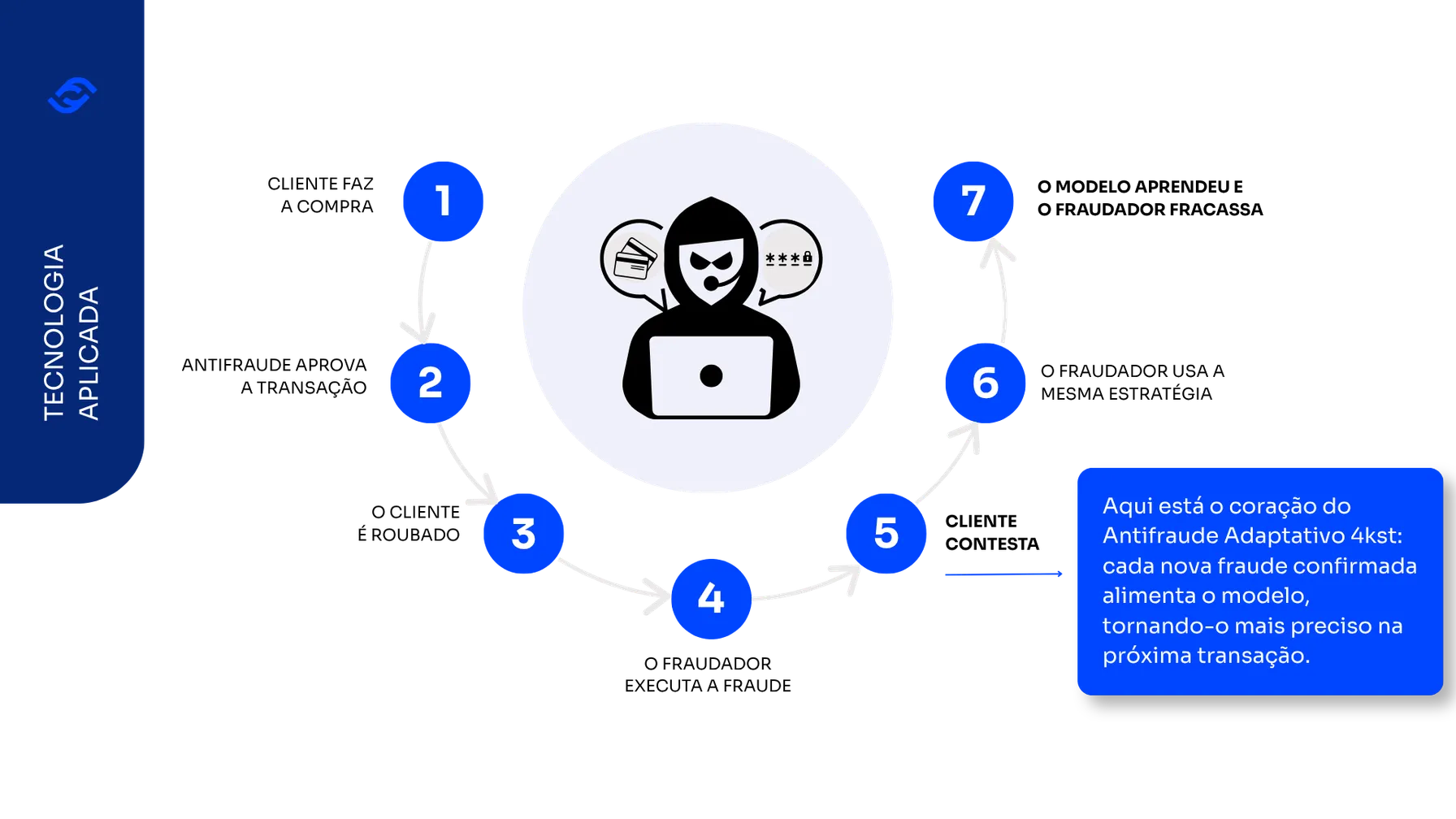
How much does that cost, in actual figures?
The figures below come from a real-world study: within the operations of a major Brazilian retail bank, a static anti-fraud model and the 4kst Adaptive Anti-Fraud model were compared side by side, using the same architecture and the same data. The only variable that changed was the methodology—a one-time training run versus continuous updating—which makes the comparison practically a controlled experiment.
In PIX PJ, the most critical segment of the study, the 4kst adaptive model detected an additional R$104 million in fraud, representing a 47.7% increase in recovery, equivalent to R$467 million in prevented losses. In TED PJ, an additional R$14.62 million in fraud was detected, representing a 66% increase in recovery, and R$65 million in prevented losses.
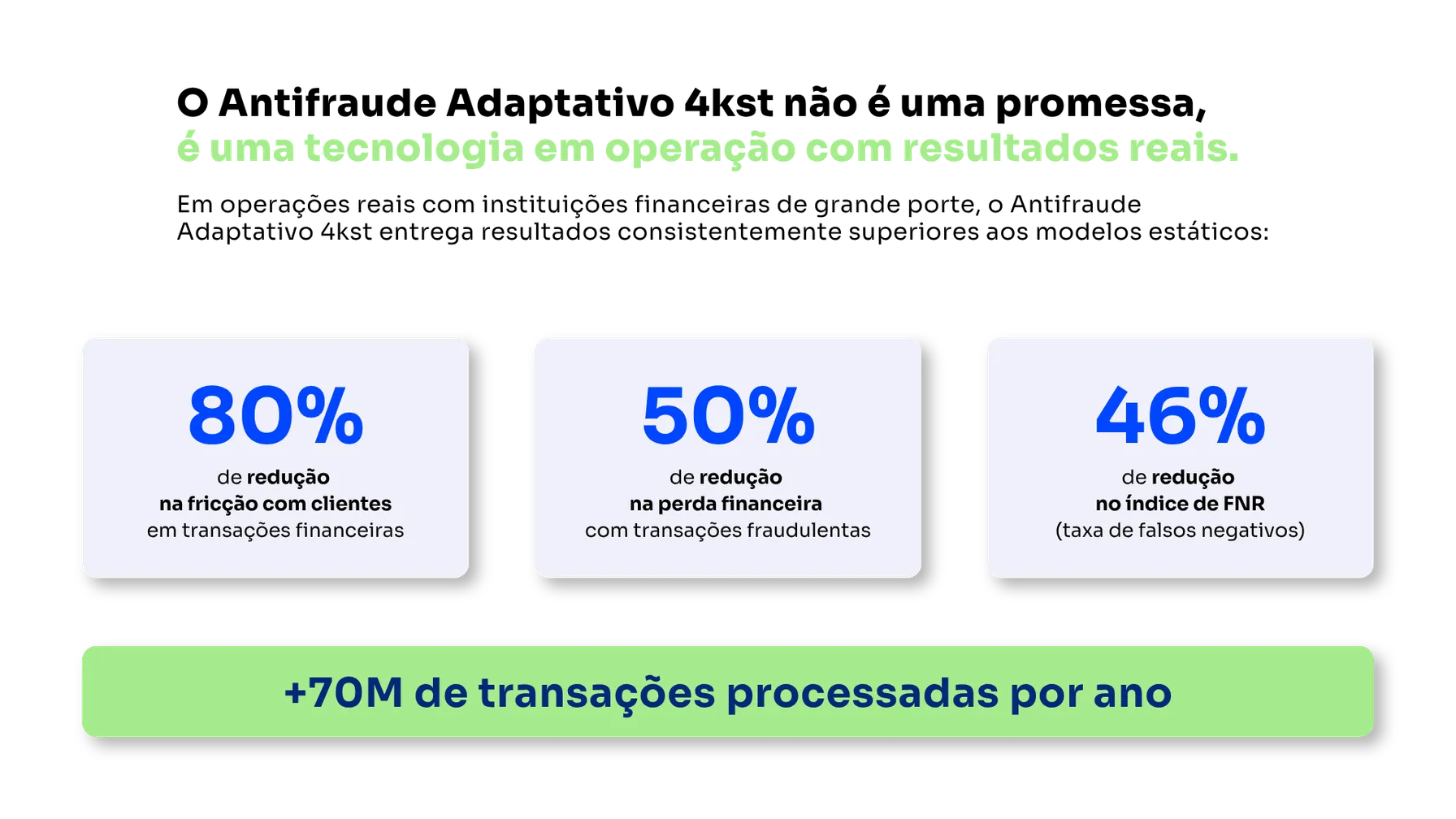
Behind these numbers lies the technical metric: in PIX PJ, the static model saw a 21% decline in KS over 15 months, and the FNR—the fraud detection rate—fell from 26% to 14% with the adaptive model, a relative reduction of 46%. In TED PJ, during a real-world attack, the static model’s detection rate plummeted from 74% to 44%, while the continuously updated model achieved a KS of 96.5% and maintained a 79% detection rate at the same friction threshold.
Taken together, these actual operations result in up to an 80% reduction in friction with legitimate customers and a 50% reduction in financial losses.
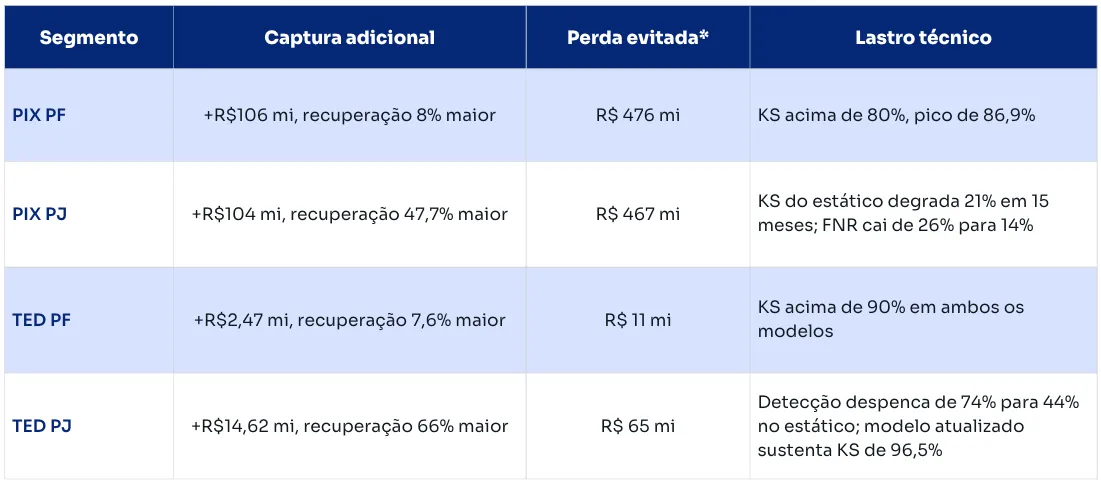
*Operating cost multiplier of R$4.49 × R$1.00 in fraudulent funds (source: Valor Econômico)
The same trend is evident in other areas of the portfolio: credit card authorization, with a 40% increase in detected fraud and a 34% decrease in undue denials; and credit card origination, with a 64% increase in approved sales and a 21% decrease in cases referred to the review desk.
These figures come from a single trade and serve as a reference for scale, not as a numerical guarantee for any new trade. Each model is validated through backtesting using data from the client’s own trades before any production decision is made.
The paradigm that solves this: Data Stream Learning
The technical solution to this problem has existed for over a decade in machine learning research, under the name of incremental learning or stream learning: instead of training a model once on a fixed batch of data and periodically replacing it, the model is continuously updated, incorporating each new event as soon as it is confirmed, without discarding what it has already learned.
When applied to fraud prevention, this approach addresses precisely the window of opportunity that fraudsters exploit. Instead of waiting for a new retraining cycle, the model incorporates the attributes of each confirmed fraud as soon as it is confirmed, closing the door before the fraudster can repeat the strategy. The model is neither retrained nor recalibrated in this paradigm; it is continuously updated—a distinction that describes a different architecture, not a faster version of the same architecture. It’s worth clarifying one more point: “real time” here refers to the model’s update, not the query, which is already real-time by default in any anti-fraud engine on the market.
It is this technology, dubbed Data Stream Learning, that generated the figures in the previous section. The company that developed this technology in Brazil—as an Adaptive AI product applied to fraud prevention—was 4kst. The continuously updated model discussed so far is the 4kst Adaptive Anti-Fraud.
This is not uncontrolled automation. Each update first goes through a template in a staging environment, running in shadow mode, and is validated before being deployed to production. The client’s internal team retains full control over what goes into production.
What this means for TCO
Lower financial losses and reduced friction aren’t the only factors in the equation. Less manual recalibration effort also contributes to the TCO—the total cost of ownership for risk and fraud operations: each periodic retraining session takes up time from the data team that could otherwise be spent on higher-value projects. It is the sum of these three reductions—financial loss, operational friction, and manual effort—that explains the direct decrease in the total cost of the operation, not just the isolated detection metric.
Frequently Asked Questions
What is concept drift? It is the change, over time, in the statistical relationship between the data a model uses to make predictions and the outcome it is trying to predict. A model trained on a pattern of behavior loses accuracy when that pattern changes, even if the model itself has not changed.
How can you tell if a fraud model is deteriorating? The first sign appears in the model’s K-smoothing (KS) metric and in the detection rate at a fixed threshold, before it becomes apparent in financial losses. A consistent decline in these metrics across retraining cycles—with no change in the model’s architecture—is the most reliable indicator.
Is this problem unique to fraud? No, but fraud is one of the most severe cases because the environment actively reacts to the model. Other prediction problems, such as churn or demand forecasting, also experience concept drift, but at a slower pace, because they don’t have an adversary on the other side deliberately adjusting their strategy.
Is continuous updating the same as retraining more frequently? No. Retraining more frequently still follows the same architecture—batch training with periodic replacement—but with a shorter interval. Continuous learning incorporates each confirmed event as soon as it occurs, without waiting for a new batch training cycle.
The argument that seals the deal
The right question isn't whether your model is good. A well-built model performs well in production; most of the market achieves that. The question is whether it remains effective six months later, twelve months later, in the midst of a real attack.
A static model structurally fails: it degrades between retraining cycles, and that interval is precisely the window that the fraudster exploits. 4kst Adaptive Anti-Fraud changes this response: it’s not that the model is better on the first day—it’s that it remains better.
The next step doesn't require you to believe in projections. It involves running the backtest with the actual data from your own operation and seeing, in reais, how much the financial loss due to fraud varies between a model that deteriorates and one that improves.
Related Articles

Stay Ahead of the Competition
Optimize your strategic decisions with the most accurate “
” forecasts on the market.
-
 Compliance with the LGPD
-
BCB Resolution No. 85/2021
-
ISO/ISE 27001:2022 Certification